Asana: Work Management
- 3.9
- Rating
- 5.00M
- Installs
- Free
- Price

 Analysis by App-foxy
I started using Asana: Work Management because my work was spread across messages, notes, calendar reminders, and half-finished to-do lists. The problem was not a lack of effort; it was that every task lived in a different place. Asana gave me one workspace for projects, individual actions, deadlines, and team discussions, and that changed how I planned the week. It is a business app from Asana, Inc., available for free and suitable for Everyone. The app has been around since February 27, 2013, and its current version is 26.33.2 for devices running iOS 11 or later.
My impression is positive, but not blindly enthusiastic. This is not a magic button that makes an overloaded team organized. It works best when people agree on how work should enter the system and when someone takes responsibility for keeping projects current. Used that way, it becomes a practical work management app rather than another place to collect forgotten tasks.
Build the workflow before filling the workspace
The most useful change I made was deciding what Asana should replace before creating projects. If every email, idea, conversation, and reminder is copied into the app without a structure, the workspace quickly becomes another source of noise. I first separated my work into active projects, recurring responsibilities, and loose ideas. That simple distinction made the app easier to use from the beginning.
You May Also Like

 Blood Strike: 2.5 Anniversary
Blood Strike’s Loadouts Turn Every Drop Into a Tactical Gamble
A close look at Blood Strike’s custom loadouts: how fast access to signature weapons reshapes its battle royale rhythm, rewards preparation, and narrows the gap between fights.

 Pandora - Music & Podcasts
Pandora’s Music Is Easy to Start, but Harder to Recover
Pandora’s strength is its low-effort path from a seed to a station. Its weak spot is how much confidence it asks you to place in connection, setup, and quiet recovery.

 8 Ball Pool
 Is Built on Rivalries, Rematches, and Routine
A close look at the rivalries, rematches, shared routines, and unanswered safety questions that turn a quick pool match into a persistent mobile community.

 Samsung Music
’s Quiet Strength Is Playing What You Already Own
Its reach comes less from spectacle than from dependable access to a personal library. That simplicity is both the app’s strongest retention engine and its ceiling.

 AccuWeather: Weather Radar
AccuWeather Review: A Quick, Clear Forecast for Everyday Decisions
For everyday plans, the best forecast is the one you can understand quickly. AccuWeather makes rain timing, radar, and local conditions easy to act on, with a few trade-offs.

 Hill Climb Racing
Why Hill Climb Racing Still Turns Crashes Into One More Run
A tiny car, a bumpy hill and one more upgrade: Hill Climb Racing keeps resurfacing because its simple chaos makes every near-miss feel personal.
More From Our News Desk



For an active project, I create a clear outcome rather than a vague label. “Prepare the client presentation” is less useful than a project whose tasks explain the actual path: gather the latest figures, outline the slides, review the draft, and send the final version. This makes the project useful to someone else, too. A teammate can understand what is happening without asking me for a private explanation.
I also try to keep one task focused on one visible action. A task called “Marketing” is too broad to guide a day. “Check the campaign copy” or “Ask design for the updated image” tells me what to do next. This is one of the app’s biggest strengths: it encourages work to become concrete. The weakness is that Asana cannot make a vague task specific for me. That discipline still has to come from the person creating it.
Before inviting a team, I recommend agreeing on a few habits. Decide whether tasks represent requests, deliverables, or small actions. Decide where questions belong. Decide who updates a deadline when plans change. Without those agreements, one person may use the app as a detailed project plan while another treats it as a personal checklist. Both approaches can work individually, but the shared workspace becomes confusing.
This preparation is especially important for small businesses and freelance teams. They often need something more structured than a chat thread but less formal than a large project-management setup. Asana fits that middle ground well. It gives work a visible home without forcing every conversation into a long meeting or a complex process.
Capture tasks while the context is still fresh
Once the basic structure is ready, I use the mobile app mainly for capture. When I am away from my desk and remember that a document needs another review, I add the task immediately instead of trusting my memory. The important part is not merely recording the thought; I include enough context to make the task understandable later.
A useful capture has three parts: the action, the destination, and the next decision. For example, instead of writing “supplier issue,” I might record the action I need to take and add a note explaining what information I am waiting for. That prevents the common problem of opening a task several days later and having to reconstruct why it mattered.
For shared work, I prefer assigning responsibility rather than leaving tasks in a general project list. An unassigned task looks harmless, but it often means nobody feels accountable. When a task belongs to one person, the team can discuss timing and dependencies more honestly. This is a small workflow choice, yet it makes a noticeable difference in projects with several contributors.
I also avoid turning every message into a task. A conversation is not automatically an action. I create a task when something needs an owner, a decision, or a visible follow-up. This keeps the project readable and stops the app from becoming a transcript of every discussion.
One less obvious benefit is that a well-written task can reduce interruptions. If the task includes the relevant background, a teammate can begin without asking the same basic questions again. That does not eliminate collaboration; it moves collaboration into a place where the details remain attached to the work instead of disappearing in a private chat.
Organize projects around decisions, not just departments
Many teams instinctively create projects for departments: sales, design, operations, and administration. That can be useful for ongoing work, but I find project-based organization more helpful when it follows an outcome. A product launch, office move, event, or customer onboarding process usually crosses several roles. Keeping those actions together makes the handoffs visible.
For recurring work, I use a consistent naming style and a predictable sequence of actions. This is a practical way to make repeated processes easier to start. A new campaign, for instance, should not depend on someone remembering every step from the previous campaign. The project can guide the work while still leaving room for exceptions.
The trade-off is that too much structure creates maintenance work. If a project contains every tiny action, people may spend more time rearranging tasks than completing them. I have better results when I reserve detailed breakdowns for work with real coordination needs. Simple personal errands do not always deserve a full project treatment.
Turn the app into a repeatable weekly routine
Asana becomes much more valuable when it is connected to a routine. I do not expect the app to tell me what deserves attention every minute. Instead, I use it at specific points: when capturing new work, when planning the week, when checking progress, and when closing completed items. This keeps the system dependable without requiring constant fiddling.
At the start of the week, I review open projects and ask four practical questions. What must move forward? What is waiting on another person? Which deadline is no longer realistic? Which task can be removed because the goal has changed? These questions are more useful than simply sorting a long list by date. A deadline can be visible and still be meaningless if nobody has checked whether the work is ready to proceed.
During the day, I choose a small set of actions that can realistically fit around meetings and unexpected requests. I do not treat every visible task as equally urgent. A project may contain many important items, but only a few should be the focus of the next working block. This is where Asana supports judgment rather than replacing it.
At the end of the day, I update the tasks that changed. If something is blocked, I make the obstacle clear. If the scope grew, I adjust the task instead of pretending the original estimate still makes sense. If the work is complete, I close it. These small updates protect the workspace from becoming a museum of old intentions.
For a realistic example, imagine a small team preparing a monthly newsletter. One person gathers topics, another writes the draft, a third checks the design, and someone else approves the final version. In Asana, each action can have a clear owner and sequence. If the draft is late, the design step should not quietly remain marked as ready. The visible handoff helps the team decide whether to wait, change the order, or reduce the scope.
That example also shows why the app is more than a personal checklist. The value comes from making dependencies and ownership visible. If I am working alone, I can still benefit from that clarity, but the shared-work advantages become stronger as soon as several people need to coordinate the same result.
Use AI and goals carefully, not as decoration
The app is positioned around coordinating work, teams, and AI, along with tasks, projects, and goals. I see the AI element as something that should support an existing workflow rather than become the workflow itself. If the project is poorly defined, automated assistance cannot fix unclear ownership or unrealistic deadlines. I get more value when the intended outcome and current status are already understandable.
Goals are also most useful when they connect to real work. A goal should help explain why a project matters and how several tasks contribute to a broader result. If goals are added only for presentation, they become another layer of administration. I prefer fewer meaningful goals that guide decisions over a long list that nobody reviews.
One advanced habit I recommend is checking whether a project’s tasks actually support its stated outcome. It is easy for extra requests to accumulate until the original purpose is hidden. A monthly review of the project’s goal and task list can reveal work that should be removed, delegated, or moved elsewhere. This protects the team from gradual scope creep.
Where the experience begins to strain
The first failure point is over-configuration. New users may create too many projects, sections, labels, and detailed task rules before they understand what the team needs. The result feels organized at first but becomes difficult to maintain. I would begin with a small number of active projects and add structure only when a repeated problem appears.
The second failure point is treating deadlines as decoration. A date is useful when it reflects a real commitment or a planning checkpoint. If every task receives an arbitrary deadline, the workspace fills with warnings that no longer help. I would rather have fewer honest dates than a complete calendar of fictional urgency.
The third is unclear ownership. A project can look busy and still have no movement if tasks are assigned to groups, left unassigned, or discussed without a next action. When a task is blocked, the blocker should be explicit. “Waiting for approval” is more informative than allowing the task to sit unchanged for a week.
Notifications can also become distracting if the team uses the app for every minor update. I recommend deciding which events truly require attention and which can wait for a review session. The app should reduce the number of places you check, not create a new stream that competes with email and messaging.
There is also a learning curve for people who are used to simple notes apps. A basic checklist may feel faster for a short personal errand. Asana earns its extra complexity when the work has multiple steps, changing priorities, or more than one person involved. If your needs never go beyond a handful of private reminders, a simpler tool may be the better choice.
Another limitation is behavioral rather than technical: the quality of the workspace depends on continued care. If nobody closes finished tasks, revises changed plans, or explains blocked work, the app gradually loses credibility. Once people stop trusting the information inside it, they return to private messages and side conversations. No project tool can prevent that without consistent team habits.
How it compares with familiar alternatives
Compared with a notes app, Asana is stronger for ownership, project boundaries, and shared progress. Notes are excellent for thinking and collecting rough material, but they usually do not show who must act next. I would keep brainstorming and reference material in a notes tool when appropriate, then move actionable work into Asana.
Compared with a chat app, it provides a more durable home for decisions and follow-ups. Chat is faster for immediate questions, but important tasks can disappear under newer messages. I use chat for quick clarification and Asana for the commitment that comes out of that conversation.
Compared with a calendar, it handles the work leading up to an event rather than only the time reserved for it. A calendar tells me when a meeting happens; a project can show the preparation, review, and approval needed before that meeting. I would not replace my calendar with Asana, but I would connect the planning habits mentally: dates show constraints, while tasks show the work.
Compared with a very lightweight to-do app, Asana offers more useful context for collaborative projects, but it asks more from the user. Someone who wants a quick list of groceries or personal errands may find the extra project structure unnecessary. Someone coordinating a launch, an editorial schedule, client work, or internal operations is more likely to appreciate the additional clarity.
Who should adopt it, and who should skip it
I recommend Asana to small and medium-sized teams that need a shared view of work without relying on scattered conversations. It is also a good fit for freelancers managing several clients, especially when each client has different deliverables and review stages. The free price makes it easy to try without turning the first experiment into a purchasing decision.
It is particularly useful when work is repeatable but not identical. A recurring process can have a familiar shape while still requiring different owners, dates, and decisions each time. The app gives that process a visible framework without forcing every project to be a perfect copy of the last one.
I would be more cautious about recommending it to someone who works entirely alone and only needs a short daily list. In that situation, the organizational benefits may not justify the effort of maintaining projects. I would also hesitate if a team is unwilling to assign ownership or review its workspace. Adoption is not just installing the app; it is agreeing to keep the information trustworthy.
The app has an average rating of 3.9 from around 45 thousand ratings, with roughly 3.1 thousand written reviews, and it has passed 5 million installs. Those figures suggest a substantial user base, but they do not remove the need to test whether its working style suits your team. I would start with one real project rather than importing everything at once.
For a first trial, choose a project with a clear finish line and several people involved. Define the outcome, assign the next actions, add only the dates that matter, and schedule a short review at the end of the week. If the team can answer “what is next, who owns it, and what is blocked?” without opening several other tools, the app is doing its job.
My final view after using it as a system
I like Asana because it rewards clarity. It helps turn loose intentions into visible work, makes handoffs easier to discuss, and gives recurring responsibilities a place to live. Its best results come from modest structure and regular review, not from filling every available space with rules.
The friction is real. Projects need maintenance, deadlines need judgment, and teams need shared habits. People looking for an effortless personal checklist may find it heavier than necessary. But for coordinated business work, that extra structure is often the point.
As a free business app from Asana, Inc., rated for Everyone and currently offered in version 26.33.2 for iOS 11 or later, it is easy to consider for a practical trial. My recommendation is to adopt it as the team’s source of truth for commitments, not as a replacement for every note, message, or calendar. When used that way, it becomes a sustainable part of a productivity system: capture work once, give it an owner, review it regularly, and remove what no longer matters.
FAQs for Asana: Work Management
01What is Asana: Work Management used for?
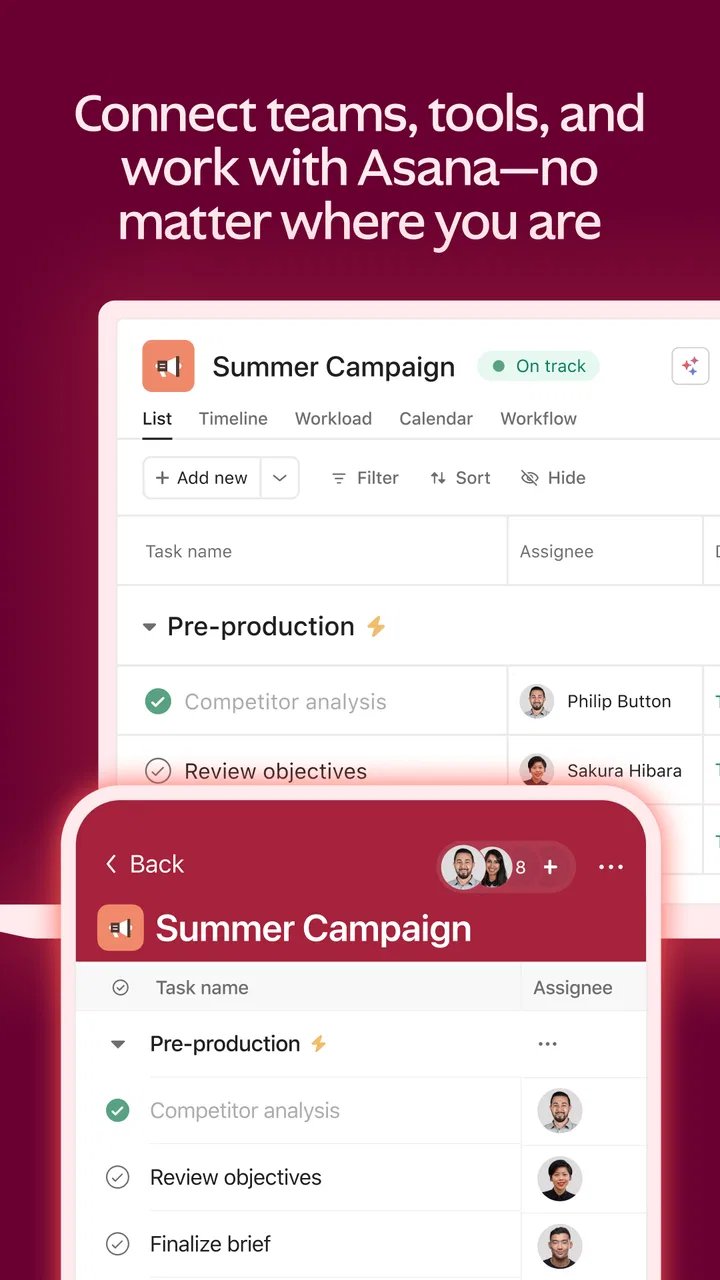
Asana is a work and project management app designed to help individuals and teams organize tasks, projects, deadlines, conversations, and files in one place. You can create projects, assign responsibilities, add due dates, track progress, and view work as lists, boards, calendars, or timelines. It is useful for business planning, marketing campaigns, product development, school projects, and personal organization.
02Can I use Asana for free, or do I need a subscription?
Asana offers a free plan with core tools for creating tasks, managing projects, assigning work, setting due dates, and collaborating with a limited number of users. Paid plans add advanced features such as timeline planning, custom fields, workload management, reporting, automation, and expanded administrative controls. The free version is suitable for basic organization, while larger teams may need a subscription.
03Does Asana work on both Android and iOS devices?
Yes, Asana provides mobile applications for Android and iOS, allowing you to manage work while away from your computer. From the mobile app, you can review tasks, update statuses, comment, upload files, receive notifications, and create new work items. Some advanced project-management features may be easier to use on the web or desktop version, especially for complex planning.
04Can Asana connect with other apps and services?
Asana supports integrations with a range of popular workplace tools, which can help reduce repetitive data entry and keep information connected. Depending on your plan and setup, you may be able to link services for communication, file storage, calendars, time tracking, automation, and development workflows. Integration availability and functionality can vary, so it is worth checking compatibility before moving an entire team to Asana.
05Is Asana suitable for personal tasks as well as team projects?
Although Asana is primarily designed for teams, it can also be useful for personal planning. You can create private projects for errands, study schedules, travel preparation, content planning, or long-term goals. Its task assignments, subtasks, reminders, and due dates make it flexible for individual use. However, users seeking only a simple checklist may find Asana more feature-rich than necessary.
Pros
- Clear task assignment
- due dates
- and project ownership
- Custom fields and views support different team workflows
- Strong collaboration through comments
- mentions
- and file attachments
- Useful templates help teams start projects faster
- Reliable web and mobile syncing keeps updates accessible
Cons
- Many advanced features require a paid subscription
- The interface can feel overwhelming for first-time users
- Notification settings may require careful customization
- Large projects can become cluttered without consistent organization
- Time tracking and budgeting tools are limited compared with specialists

Asana: Work Management
Gallery